



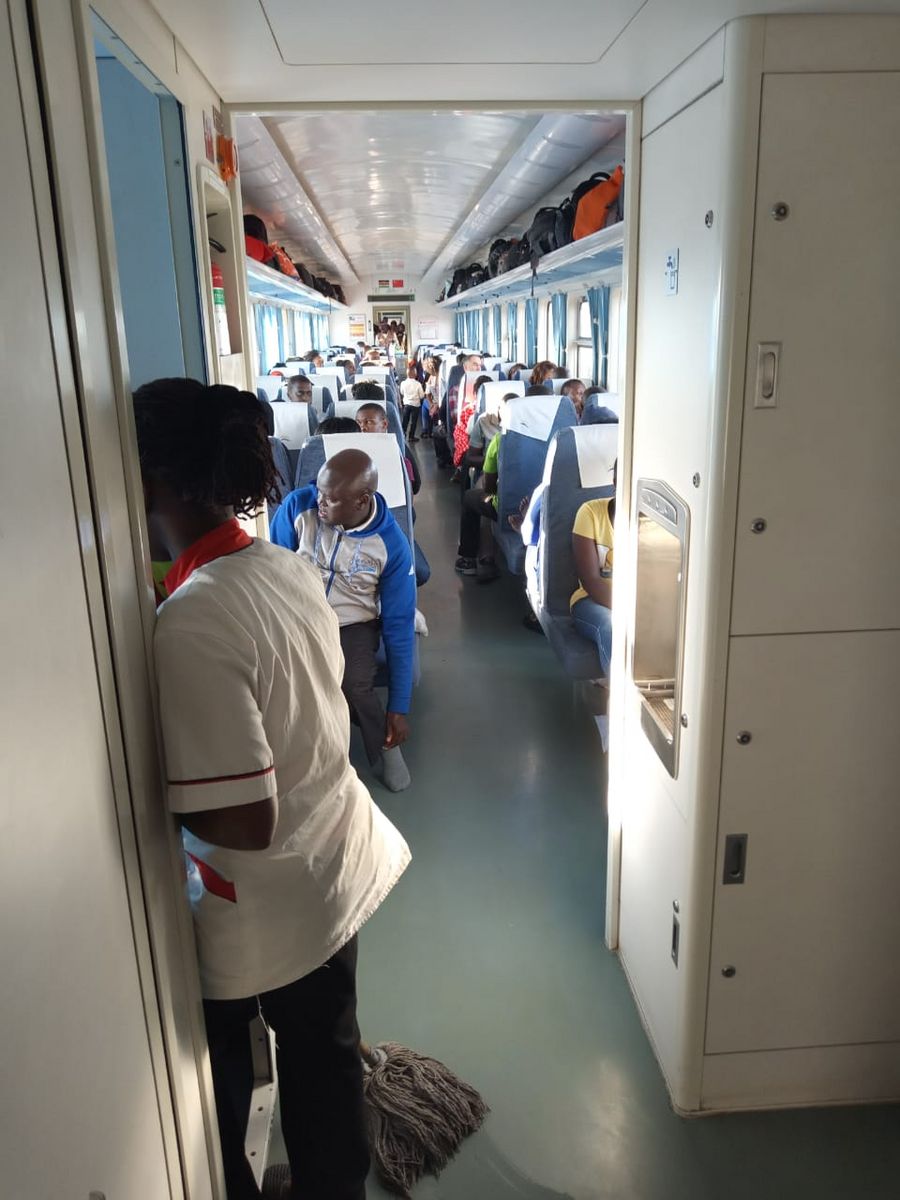
Passengers travel on the standard gauge railway to Mombasa, Kenya, Nov. 17, 2019. (Xinhua/Bedah Mengo)
The modern standard gauge railway increasingly becomes the chief mode of transport for Kenyans. Travellers say the Chinese-built railway saves costs, reduces travel time, and is highly reliable.
NAIROBI, Nov. 19 (Xinhua) -- Kenya's modern railway linking the capital city Nairobi to the coastal city Mombasa increasingly becomes the chief mode of transport between these two destinations. Travellers say the Chinese-built railway saves costs and reduces travel time compared to road travel. Meanwhile, it's also highly reliable.
Beatrice Kimani, a resident of Nakuru, Kenya's fourth-largest town northwest of the capital Nairobi, recalled her trip to Mombasa for a meeting two days ago.
In the past, she would board a bus in Nakuru to Mombasa for a direct journey. But for this time, she boarded a public transport mini-bus to Nairobi then made the rest of the journey via the standard gauge railway train.
It is a route many upcountry Kenyans traveling to the coast are now taking as they seek convenience, quality and affordable transport, with the train charging 1,000 shillings (about 9.8 U.S. dollars) for economy class from Nairobi to Mombasa.
Some citizens are traveling by bus from as far as Busia in western Kenya to Nairobi then boarding the train dubbed Madaraka Express to Mombasa.
"It is cheaper, it's faster and convenient. We arrived in Mombasa at about 7 p.m. If I had boarded a bus, I would have arrived one or two hours later and very tired," said Kimani on Monday.
She noted that one needs good planning to ensure they don't miss the train.
"You have to buy the train ticket well in advance especially at this time of the year because many people are traveling," said Kimani.
On Sunday, she left her Nakuru home at 8 a.m. to ensure she reaches at the Madaraka Express station in Nairobi on time.
"I was taking the afternoon train that leaves the station at 2.35 p.m. I was there by 12.45 p.m., which was a good time to go through the security checks and get ready for the journey," she said.
Those travelers coming from far places like Kisumu, Bungoma and Busia in western Kenya take the night bus and arrive in Nairobi early morning for the 8.35 a.m. train.
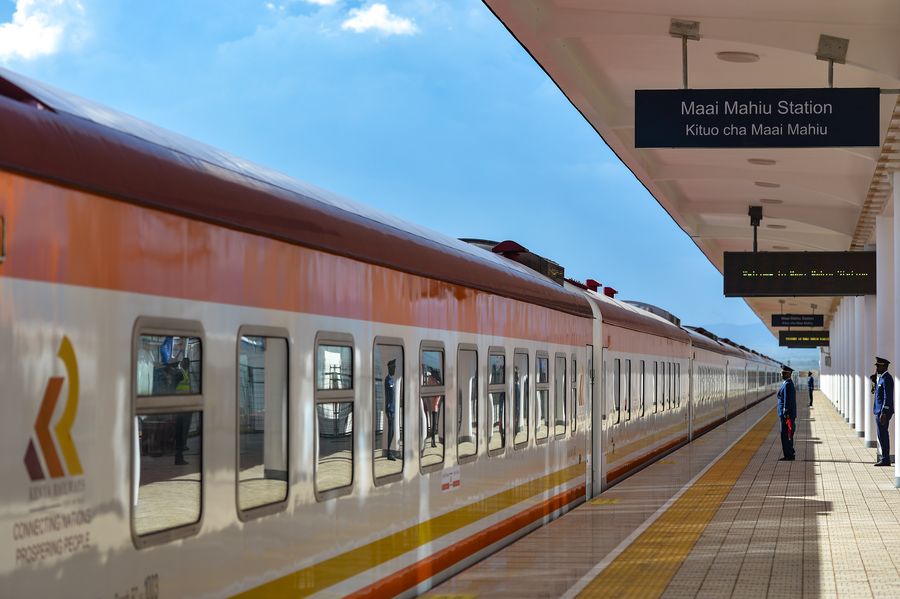
The train of Kenya's standard gauge railway (SGR) Phase 2A leaves Maai Mahiu Station, Kenya, on Oct. 16, 2019. (Xinhua/Li Yan)
"It costs up to 28 U.S. dollars to travel by bus from Busia to Mombasa or even higher during peak season, but with the train, I save 6 dollars," said Vincent Okwaro, a resident of Busia who works in Mombasa and travels regularly to visit his family at his rural home.
Apart from common travellers, some Kenyan corporates, which used to book air tickets for their employees that go for up to 240 dollars, have also switched to the train.
This includes government parastatals, non-governmental institutions and private sector businesses.
The institutions, which initially would incur huge costs on transport, are saving a great deal on costs thanks to the train.
"With the standard gauge railway around, the company cannot book the plane for employees as in the past," said Peter Onyango, a journalist in Nairobi.
He traveled to Mombasa on November 14 for a weekly assignment and booked his return ticket for Tuesday.
According to the Chinese operator which runs the passenger service, the standard gauge railway train had ferried about 3.3 million passengers to and from Mombasa and Nairobi until August 8.
Ernest Manuyo of Pioneer Institute in Nairobi said the train has already won the hearts of Kenyans due to its quality services. ■
